




Postcards
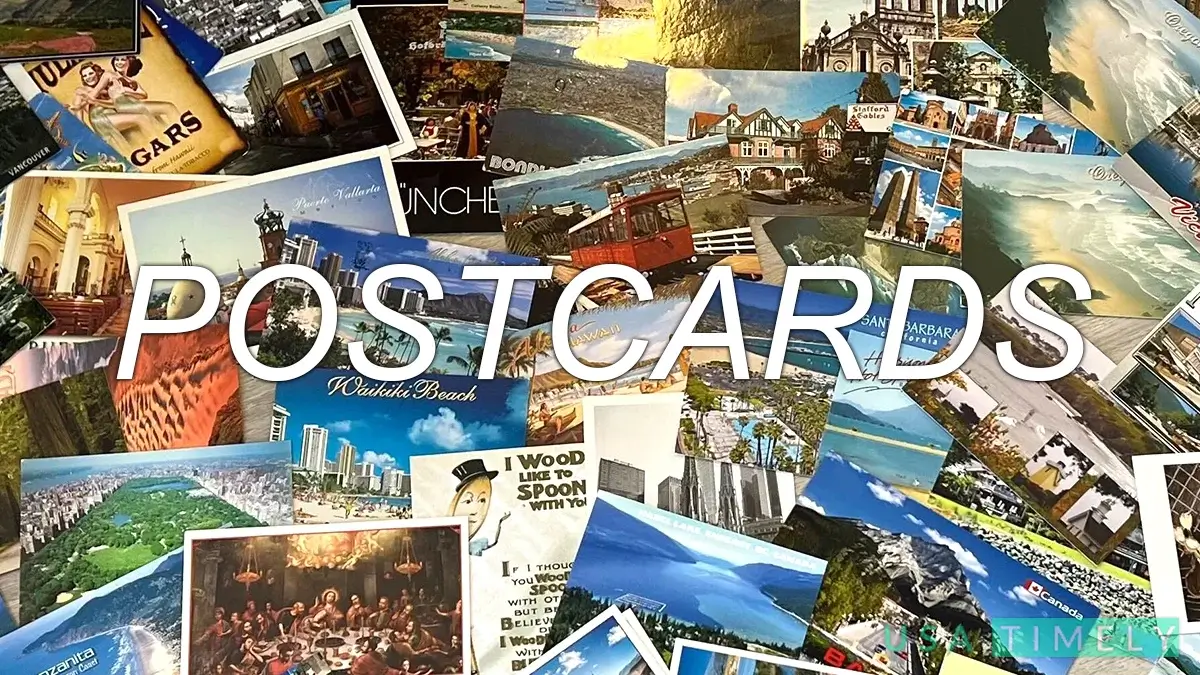
Postcards are those sturdy pieces of paper or cardboard that comes mostly in a rectangle shape. However, it’s not too unusual to spot one in a different shape, even though that’s pretty rare. They’re designed for easy writing and direct mailing, no need for an envelope.
Postage Details
Interestingly, sending a postcard might not hit your wallet as hard as mailing a standard letter. This cost-saving trick catches the eye of stamp enthusiasts who draw a line between postcards, which need a stamp, and postal cards. Postal cards are the ones that come with the postage already printed on them. While anyone from a private entity to a local organization can churn out postcards, postal cards are officially released by the postal authorities.
The Golden Era of Postcards
The end of the 19th century and the dawn of the 20th century witnessed a postcard boom. They quickly became the go-to method for dropping a quick note to someone. Their popularity soared because of their simplicity and ease of use.
Deltiology: The Art of Collecting Postcards
The fancy term for postcard collecting is deltiology, a word that marries the Greek word for “small writing tablet” with “-logy,” which means “the study of.” It’s a hobby that has captivated many, turning simple postcards into coveted items for collection.
Postcard Early Days (1840-1864)
- Lipman’s Postal Card: People have been crafting and sending cards with messages since the postal service began. One of the earliest examples was in 1840 when Theodore Hook, a writer, sent himself a hand-painted card as a joke on the postal service. It featured a caricature of postal workers. This card, with a penny black stamp, sold for a whopping £31,750 in 2002.
- Invention of Commercial Cards: In the United States, the trend of sending picture or blank cards through the mail started in 1848. The first commercially produced card appeared in 1861, created by John P. Charlton of Philadelphia. He patented it and sold the rights to Hymen Lipman, who marketed them as “Lipman’s Postal Card.” These cards didn’t have images initially.
Evolution of Postcards (1865-1880)
- Introduction of “Open Post-Sheets”: In 1865, Heinrich von Stephan, a Prussian postal official, suggested the idea of “open post-sheets” made of stiff paper. But it was rejected for being too radical. However, Austria-Hungary accepted a similar proposal in 1869. During the Franco-Prussian War in 1870, postals were issued for soldiers to send home cheaply from the battlefield.
- Rise of Picture Postcards: The first printed picture postcard, with an image on one side, emerged in France in 1870. Meanwhile, in Germany, August Schwartz is credited with inventing the illustrated postcard in 1870. Advertising cards started appearing in Great Britain in 1872, followed by Germany in 1874. Private cards, like Lipman’s, were produced alongside government postals.
The Golden Age (1890-1915)
- Boost from the Eiffel Tower: The 1880s saw a surge in postcards, especially after the construction of the Eiffel Tower in 1889. This period, dubbed the “golden age,” took off slightly earlier in Europe than in the United States. The Chicago World’s Fair in 1893 also played a significant role in popularizing picture postcards.
- Technological Advances: From 1905 to 1915, the golden age peaked in the United States due to social, economic, and technological factors. The demand for postcards soared, aided by advancements in photography, printing, and mass production. The expansion of Rural Free Delivery further fueled the boom.
Post-World War I Era (1918-Present)
- Changing Trends: After World War I, postcard production continued but with changes in styles. Telephone usage grew, reducing the demand for postcards as a means of communication. Publishers shifted focus to scenic views, humor, and fashion. Different types of postcards like “white border” and “linen” emerged in the 1930s and 1940s.
- Modern Era: The modern era of colorful, glossy postcards, known as Photochrom or “chrome” postcards, began around 1950. However, postcard sales declined with the rise of social media in the 2000s. Long-established printers faced closure due to this shift in communication trends.
Postcards around the World
India’s Postal Revolution
Back in July 1879, India’s Post Office did something groundbreaking: they launched a quarter anna postcard, making it the most affordable way for its citizens to send messages across British India. This innovation wasn’t just a hit; it revolutionized communication, ensuring that a postcard could travel from one corner of the country to another without any extra postage. This system, which started in the colonial era, still benefits independent India today, highlighting its lasting impact.
Japan’s Unique Postcard Culture
Fast forward to December 1873, Japan stepped into the postcard game shortly after embracing stamps. The introduction of return postcards in 1885, sealed postcards in 1900, and the allowance of private postcards marked Japan’s evolving postal services. Japan has some unique postcard practices like the New Year’s Day postcards (nengajō), akin to Western Christmas cards, and return postcards (ōfuku-hagaki) that ease the process of getting a reply without imposing postage costs on the receiver. These traditions underline Japan’s innovative approach to postal communication.
Russia’s Postal Standards
By 2000, Russia had set clear standards for postcards with GOST 51507-99, categorizing them based on features like whether they’re stamped or not and if they include illustrations. This classification shows Russia’s methodical approach to postal communication, ensuring clarity and efficiency in how postcards are used and sent, both within the country and internationally.
The Evolution of Postcards in the United Kingdom
The UK’s journey with postcards began in 1870 when the Post Office launched image-less postcards with a pre-printed stamp. This move was a hit, with 75 million cards circulated in just a year. The introduction of PHQ Cards in 1973 further enriched the UK’s postcard culture, becoming a collector’s delight.
The seaside postcard, which became popular in 1894, showcases Britain’s humor and social commentary, evolving over the decades to reflect changing societal norms and attitudes. Despite fluctuations in their popularity, these postcards have remained a cherished part of British cultural and tourist memorabilia.
The United States Postal Service’s Definition
In the United States, postcards have a specific definition set by the Postal Service, outlining their size and thickness. This standardization underscores the practical aspect of postcard usage in America, balancing tradition with regulatory requirements.
From India’s pioneering cheap postcards to Japan’s unique traditions, Russia’s methodical classification, the UK’s cultural icons, and the US’s standardization, postcards serve as more than just a means of communication. They’re a reflection of each country’s culture, history, and approach to connecting people across distances.
Legal Issues and Censorship of Postcards
Crossing Borders with Caution
The advent of picture postcards sparked legal debates as they crossed national lines. The acceptance of a postcard’s image in one country did not ensure its acceptance elsewhere. Some countries rejected postcards with sexual themes or nudity, while others banned religiously sensitive imagery. For instance, the U.S. mandated a black bar cover for any nude male figures depicted from the back on British postcards. Early on, nude photography postcards, known as “French postcards” in the U.S., were illegal to produce domestically. The Ottoman Empire, in 1900, prohibited materials that depicted the Islamic prophet Muhammad, making postcards that slipped through before this ban highly valuable to collectors.
The Comstock Act and Lynching Imagery
The Comstock Act of 1873, aiming to curb “obscene matter” in the mail, indirectly addressed lynching postcards. While not outright banning these images, the act targeted racist texts on postcards, considering them more incriminating. Some communities self-censored lynching photos, but the real change came with §3893 of the Act in 1908, focusing on texts that could incite violent crimes. Nonetheless, lynching postcards continued to circulate, often concealed in envelopes to bypass censorship.
World War I: The Height of Postal Censorship
World War I saw extensive censorship by all involved nations to protect military secrets and control morale. The U.S. enacted the Espionage Act of 1917 and Sedition Act of 1918, granting the government broad censorship powers. A Central Censorship Board oversaw mail and cable communications, with certain centralized post offices handling suspect correspondence. Allied efforts varied in intensity, with Britain and America leading in sweeping censorship operations, while France opted for a more targeted approach.
Soldiers found creative ways to evade censorship, like sending messages while on leave from remote locations. Despite censorship, soldiers and civilians continued to send various types of postcards, including government-issued ones, picture postcards, and keepsake embroidered cards. Censors were particularly wary of picture postcards, often destroying those deemed inappropriate or propagandistic, such as those promoting hostility towards the enemy.
The Historical Significance of Postcards
Postcards have served as a visual archive of both natural landscapes and human-made structures, including buildings, gardens, parks, cemeteries, and tourist attractions. They offer glimpses into society during times when images in newspapers were rare. Postcards made it easy for people to stay connected with friends and family, requiring only brief messages. Photographers with postcards were present at significant events—be it celebrations, disasters, political movements, or wars—capturing the essence of those moments. They commemorated various aspects of daily life, such as humor, entertainment, fashion, transportation, sports, work, religion, and advertising, and were used to share news about life events, purchases, and employment opportunities.
A Window into the Past
Postcards are invaluable primary sources for historians, preservationists, and genealogists, offering insights into both the tangible and societal aspects of the past. They played a revolutionary role in communication, paralleling today’s social media impact. Researchers utilize postcards to explore diverse subjects, including theater, racial attitudes, and the impacts of war.
Bringing Postcards to the Digital Age
Libraries, archives, and museums boast extensive postcard collections, many of which have been digitized. Professionals in these fields are actively working to digitize these collections, aiming to enhance public accessibility. For those interested, numerous large digital postcard collections are already available online, serving as a treasure trove of historical insight accessible from anywhere in the world.
The Art of Collecting Postcards
Birth of Postcard Collecting
The hobby of collecting postcards likely took off as soon as people started sending them. The real momentum for collecting began with the production of souvenir postcards at world’s fairs, aimed directly at collectors seeking keepsakes. As the golden age of postcards dawned, collecting transformed into a widespread phenomenon. This era saw the emergence of “postcarditis,” a term coined to describe the fervor with which people bought, mailed, and amassed postcards, with collectors accounting for up to half of all purchases.
Clubs and Communities
To support this growing interest, clubs like The Jolly Jokers, The Society for the Promotion of Post Cards, and the Post Card Union were established, boasting thousands of members eager to exchange postcards. Victorian homes often featured postcard albums in their parlors, highlighting the cultural importance of this hobby among the middle and upper classes.
Modern Day Collecting
Today, postcard collecting remains a beloved hobby around the globe. A postcard’s value is primarily judged by its illustrated image, but factors such as country of origin, issuer, and author can also play significant roles. Collectors now have access to online catalogs through various websites and clubs, offering extensive details and images for each postcard. These online resources also provide tools for managing collections, platforms for trading, and forums for discussion among enthusiasts. The Metropolitan Postcard Club of New York City holds the title of the oldest active postcard club in the United States, established in 1946.
Postcard Terminologies
We have explained some of the most prominent postcard terminologies:
- 3D Postcard: These postcards display artwork that appears three-dimensional, achieved through techniques like lenticular printing or holograms.
- Advertising Postcard: Produced by marketing companies, these postcards are often available for free in commercial locations and serve as promotional tools rather than items intended for mailing.
- Appliqué: Postcards with additional materials like cloth, metal, or other embellishments attached to them.
- Art Déco: An artistic style prominent in the 1920s, characterized by symmetrical designs and straight lines.
- Art Nouveau: An artistic style from the turn of the century featuring flowing lines and floral symbols, often with an impressionistic touch.
- Artist Signed: Postcards featuring artwork with the artist’s signature, often unique to postcards.
- Bas Relief: Postcards with a raised surface, giving them a papier-mâché appearance.
- Big Letter: Postcards displaying the name of a place in large letters, each containing a picture of that locale.
- Composites: Individual cards that, when arranged together, form a larger picture or scene.
- Court Card: The official size for British postcards between 1894 and 1899.
- Divided Back: Postcards with a back divided into two sections for the message and address, introduced in Britain in 1902 and the US in 1907.
- Early: Refers to any card issued before the introduction of the divided back (pre-1907).
- Embossed: Postcards with a raised surface texture.
- Exaggeration: Postcards featuring exaggerated elements, often created using trick photography.
- Folded: Postcards with multiple pages, typically needing to be mailed in an envelope.
- Hand-tinted: Black-and-white images tinted by hand with watercolors and stencils.
- Hold-to-Light: Postcards depicting nighttime scenes with cut-out areas to show light.
- Intermediate Size: Postcard size between Court Cards and Standard Size.
- Kaleidoscope: Postcards with a rotating wheel revealing various colors and patterns.
- Large Letter: Postcards displaying the name of a place with large letters, each containing a picture of that locale.
- Maximum Card: Postcards with a postage stamp placed on the picture side and tied by the cancellation.
- Midget Postcard: Novelty cards smaller than standard size.
- Novelty: Postcards deviating from the norm in various ways, including size, shape, or materials used.
- Oilette: A trade name for postcards reproduced from original paintings.
- Postcard Folder: A set of picture postcards folding out accordion-style from an outer envelope.
- Postcardese: The style of writing commonly used on postcards, characterized by short sentences and varied subjects.
- QSL Card: Postcards confirming successful reception of a radio signal on amateur radio.
- Real Photographic: Postcards produced directly from an original negative, not printed.
- Reward Card: Postcards given as rewards to school children for good work.
- Special Property Card: Postcards made of materials other than cardboard or containing non-cardboard elements.
- Standard Size: The standardized postcard size introduced in Britain in 1899.
- Topographical: Postcards showing street scenes and general views.
- Undivided Back: Postcards with a plain back used entirely for the address, common before 1907.
- Vignette: A design on postcards that does not occupy the entire picture side, often leaving space for writing.
- Write-Away: Postcards featuring an opening sentence for the sender to complete, often found on early comic cards.
Conclusion
In the digital age, postcards may seem like relics of the past, but their enduring significance cannot be understated. From their humble beginnings as simple means of communication to becoming cherished collectibles and historical artifacts, postcards have traversed through time, reflecting the evolution of societies, cultures, and communication methods.
While social media and instant messaging platforms have largely replaced traditional postcards for everyday communication, the charm of these tangible tokens endures. They serve as windows into the past, capturing moments, memories, and messages that transcend generations. The art of collecting postcards continues to thrive, connecting enthusiasts worldwide and preserving a unique slice of history.
As we navigate the complexities of modern life, it’s worth taking a moment to appreciate the simplicity and beauty encapsulated within these small pieces of paper. Whether it’s the scenic vistas of faraway lands, the humorous illustrations that bring a smile to our faces, or the heartfelt messages exchanged between loved ones, postcards remind us of the timeless joy found in connecting with others, one small square at a time.